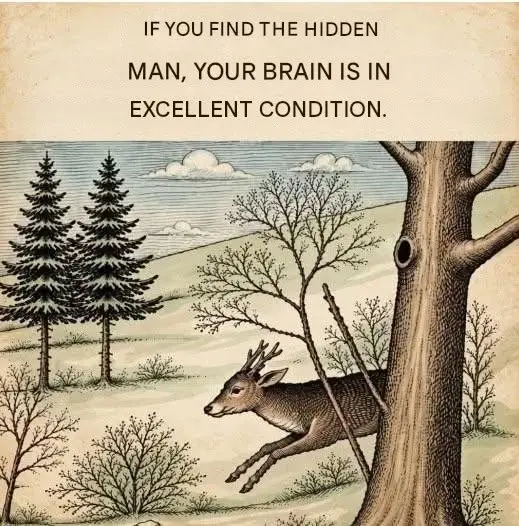
A silent forest under the snow, a deer resting among the trees… The photo seems quite serene, almost postcard-perfect. However, this image hides a secret that most people don’t notice at first. Somewhere among the trunks, branches, and shadows lies the outline of a human face. The question is simple: is your brain sharp enough to detect it?
Why does your gaze always fall first on the deer?
This is a perfectly normal mechanism. Our brain is a machine for finding familiar shapes. As soon as it identifies a recognizable silhouette—like that of a deer with its antlers, legs, and well-defined body—it latches onto it and stops looking elsewhere. Mission accomplished, it thinks.
As a result, everything else in the image fades into the background. The bent branches, the shaded areas, the patches of snow between the trees… it all goes completely unnoticed. And that’s precisely where the face is hidden.
Tips for finally watching it
If you’ve been staring at the image for several minutes without success, don’t panic. Simply change your appearance. Here are some techniques that really make a difference:
Detach yourself from the deer. As long as it remains your focal point, the face will remain invisible. Willfully look elsewhere.
Look at the spaces between the trees. The answer isn’t hidden in the trunks, but in the gaps between them.
Squint slightly. This simple trick blurs the details and reveals the overall silhouettes.
Step back from the screen. Taking a little physical distance helps a lot in perceiving the overall shapes rather than isolated elements.
Play with contrasts. Light and dark areas often form facial features: an eyebrow here, an eye there, the line of a cheek further away.
What science calls pareidolia
This phenomenon has a name: pareidolia . It’s this natural tendency of our brain to recognize faces or human figures in everyday objects—clouds, building facades, stains on a wall. We’ve all experienced it.
But when a distraction as powerful as the deer takes center stage, even this natural mechanism is disrupted. The brain settles for its first logical interpretation and questions nothing.