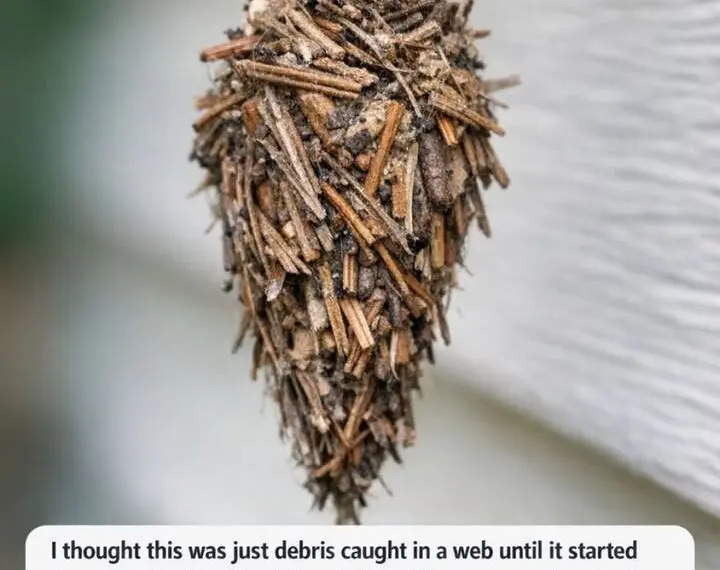
At first glance, it looks like nothing more than a clump of debris—dried pine needles, tiny twigs, and dust tangled together in a messy web. But then it moves. Slowly, almost eerily, it drags itself along the wall, revealing a small dark head peeking out.
So what exactly are you looking at?
You’ve just encountered one of nature’s most fascinating little builders: a bagworm.
🐛 What Is a Bagworm?
A bagworm is the larval stage of a moth belonging to the family Psychidae. What makes it truly unique is the protective “bag” or case it builds around itself using materials from its environment.
In your image, the cone-shaped structure made of pine needles and twigs is not random debris—it’s a carefully constructed mobile home.
Inside that case lives a caterpillar that:
- Collects bits of plant material (like needles, bark, or leaves)
- Attaches them with silk
- Expands the case as it grows
- Carries it everywhere for protection
The small black “head” you see poking out is the larva emerging briefly to move or feed.
🏠 Why Does It Build This Case?
The bag serves multiple purposes:
1. Protection from predators
Birds and insects have a hard time recognizing it as prey because it blends perfectly with its surroundings.
2. Camouflage
Each bagworm uses materials from its immediate environment, making it nearly invisible on trees, fences, or walls.
3. Shelter
It acts as a shield against weather conditions like wind, rain, and heat.
🌿 Where Are Bagworms Usually Found?
Bagworms are commonly found:
- On trees (especially pine, cedar, and evergreen species)
- On shrubs and hedges
- On house siding, fences, and outdoor structures
In your case, it likely moved from a nearby plant onto the wall.
⚠️ Are Bagworms Harmful?
TO CONTINUE READING THE ARTICLE PLEASE SEE PAGE 2