HomeIt took me a while …see more
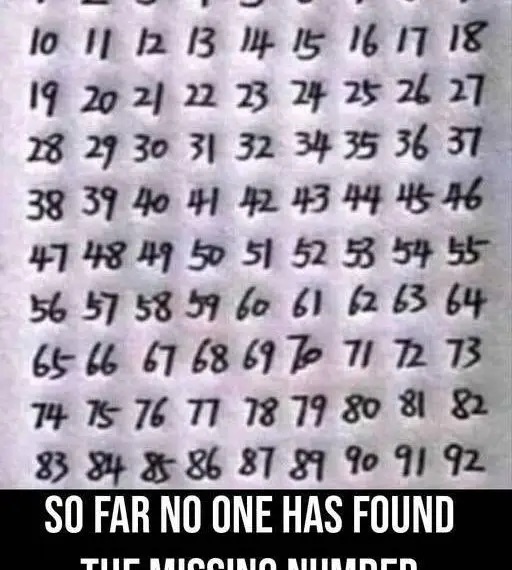
At first, a number grid from 1 to 92 seems ridiculously easy.
You glance at it and think:
“How could anyone miss a missing number?”
But then your eyes start moving across the rows… and suddenly the mistake becomes strangely hard to spot.
That’s because puzzles like this cleverly exploit how the human brain processes patterns and expectations.
In your example, the missing numbers are:
33 (between 32 and 34)
88 (between 87 and 89)
And many people overlook them repeatedly—even after being told they exist.
So why does this happen?
1. Pattern Completion (Your Brain Auto-Fills Information)
One major reason is something called:
Pattern Recognition
Your brain is extremely efficient.
Instead of carefully reading every single number, it quickly recognizes:
“This looks like a counting sequence”
“Everything appears normal”
Then it unconsciously fills in what it expects to see.
So when your eyes move from:
32 → 34
your brain silently inserts:
“33”
even though it’s not actually there.
2. Cognitive Shortcuts (Mental Efficiency)
The brain constantly uses mental shortcuts called:
Cognitive Bias Carefully checking every number would take unnecessary energy, so your mind prioritizes speed over precision.
That’s usually helpful in everyday life—but it makes puzzles like this surprisingly effective.
3. Skimming Instead of Reading
Once the first few rows appear correct, most people stop truly reading the grid.
Instead, they:
Scan quickly
Assume consistency
Focus more on rhythm than detail
This creates “inattentional blindness,” where obvious information gets overlooked because attention is elsewhere.
Why Viral Brain Teasers Feel So Addictive
Puzzles like this trigger a small mental conflict:
Your brain expects the answer to be easy
But the mistake remains hidden
That tension creates curiosity and keeps people searching longer than expected.
In Cognitive Psychology, this kind of challenge is connected to how humans process visual information and expectations.
What These Puzzles Reveal About the Brain
They remind us that:
Seeing isn’t always the same as noticing
The brain often prioritizes efficiency over accuracy
Expectations strongly shape perception
In other words:
Your brain doesn’t always show you reality exactly as it is—it shows you what it expects to see. Frequently Asked Questions
Why do smart people miss simple mistakes?
Because intelligence doesn’t prevent cognitive shortcuts.
Does everyone’s brain do this?
Yes—pattern completion is a normal part of human perception.
Why are repeated sequences harder to check?
The brain becomes less attentive when information feels predictable.
Can brain teasers improve attention?
They may help strengthen focus and observation skills over time.
Final Thoughts
This “missing number” puzzle feels tricky not because the numbers are hidden well—but because your brain is too good at recognizing patterns.
Ironically, the smarter and faster your brain processes information, the easier it can be to overlook tiny inconsistencies hiding in plain sight.
And honestly… once you finally spot the missing numbers, it’s impossible to understand how you missed them the first ten times